• Compare Liberal Arts Colleges
    • Big 10 Comparison Analysis

Liberal Arts Colleges

the Complete Guide to Liberal Arts Colleges

  • Home
  • College Essay Help
  • College Acceptance Rates
  • School Comparisons
  • College Rankings
  • Write for Us
You are here: Home / Schools / Trinity College

Trinity College

Hartford, CT
Take me to Survey Results
Trinity College

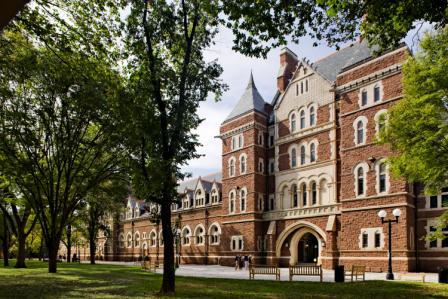
Photo: Trinity College. Retrieved from: www.wikipedia.org

Trinity College is the second oldest college in Connecticut, with Yale University being the only older university. The student body of 2,300 students is considered small when compared with big universities and public colleges, but this small school is one of the little Ivies, or the schools that can rival the Ivy League universities when it comes to academic standards. Trinity College offers 38 majors and 26 minors, and maintains small class sizes to facilitate learning and improve student-faculty interaction.

School History

In 1823, Rt. Rev. Thomas Brownell founded an institution in Hartford and called it Washington College, which would later be changed to Trinity College. Having been founded by an Episcopal bishop, Trinity College was initially not given a charter from the state. The charter was eventually given on the condition that the college must not force its religious standards on its students, teaching staff and other employees. Trinity’s first campus was made up of Greek Revival buildings, including a chapel, library, a dormitory and several lecture rooms. The college changed its name in 1845.

Trinity College at the end of the nineteenth century was more of a local institution than a regional one. When the University of Hartford was founded, Trinity College was able to concentrate on expanding the system and accepting students from the region. The iconic Gothic Chapel in Trinity College was completed in 1932 during the presidency of Remsen Ogilby. The need for a bigger chapel was due to the expanding school population, and Seabury chapel was not big enough to accommodate everyone.
In 1968, the board of trustees of Trinity College decided to accept more minority students, endowing financial aid to some that needed it. Originally a college for men, the school became coeducational in 1969.

Campus Life

Students can choose from over 100 student clubs and organizations. Active clubs reach out to the community and help each member build leadership skills. There are organizations that have international students as members, and this club celebrates culture as well as diversity. There are fund raising groups that organize charity events for worthwhile causes like the American Cancer Society. The Outing Club is one of the most popular because of the annual and monthly treks, scuba diving and travelling to various destinations.

The surrounding area makes life colorful for students, especially the civic centers and the theaters. Studying until the wee hours of the morning should not be too hard when there are plenty of 24-hour restaurants around that do deliveries on campus.

Trinity students strike a good balance between work and fun. The libraries are packed with students during the weekdays, while the social areas on campus such as Vernon Street are packed with students during the weekends. The routine to work hard and play hard is so compulsive that many new students fall into the habit of mimicking the upperclassmen when it comes to balancing parties and studies.

One of the major concerns about Trinity and its surrounding areas is the neighborhood surrounding the campus. The Campus Safety Department is on guard twenty-four hours a day and committed to securing the college community. There are hotlines to call for any emergency, including a hospital hotline and a campus security hotline.

Financial Aid

Most students receive need-based financial assistance from scholarships and grants given by Trinity, and the qualifications for aid are determined based on the documents that the student submits. The rest receive financial assistance from federal, state, and private funds. The average debt at graduation is around $25,000.

  • Overview
  • Community & Safety
  • Academics
  • Social Life

Overview

Despite college rankings and countless beautiful college websites, most students and families know very little about the actual student experience at particular schools. College websites, campus tours and conversations with high school guidance counselors provide very limited information.

The Voice of the Student Survey compares the responses of over 7,500 liberal arts college undergraduates on more than 40 questions about college life. As a result, we learned what “real life” looks like at individual schools.

Some of the best (and worst) performers in our research are surprising. Some are among the U.S. News & World Report’s top ranked liberal arts colleges in the country, while others are ranked much lower but provide a successful student experience.

Our Liberal Arts Insider members know exactly how these colleges compare.

We surveyed thousands of liberal arts students to help you get the real scoop about the student experience… the good, the bad and the ugly.

Campus Community Coach & Safety Sherpa

How safe, accepted, and comfortable students feel on their college campus is one of the largest influencing factors as to how satisfied they feel with their college experience. Having a tight-knit college community is the cornerstone of a successful college experience, as proven by our Voice of the Students survey.

We can compare what the college brochures advertise to what students are actually experiencing; sometimes the admissions representatives have no idea how students on their campus really feel. This “Community” section is a way to find out exactly what students think about their campus, in their own words. Here, we have data about student satisfaction, housing, social cliques, and student’s sense of safety.

Get Our In Depth Analysis of Liberal Arts Colleges

The smartest way to cut through the college marketing hype and pick a college that is a perfect fit for your child is to become a Liberal Arts Insider member. Our research reveals inside information that colleges will never tell you.
Learn More

Academics Advisor

Without a doubt, academics are a major focus, if not the top priority, for many college students. Schools will often advertise their classrooms as collaborative, but we’ve found that students sometimes describe the academic environment as highly competitive. Are students helping each other with academic work or trying to get ahead? Do students spend every waking moment with their nose in a book?

We asked students both qualitative and quantitative questions to find out how the academics at this school challenge them, and contribute to their college experience. Find out directly from the students how they feel about academics, challenging or otherwise, at their school.

Get Our In Depth Analysis of Liberal Arts Colleges

The smartest way to cut through the college marketing hype and pick a college that is a perfect fit for your child is to become a Liberal Arts Insider member. Our research reveals inside information that colleges will never tell you.
Learn More

Social Life Navigator

In addition to academics, social life is integral to the campus experience, and it’s dictated by a few different elements. Do students feel discriminated against based on their identities? Where do students spend most of their time socializing? Do drugs and alcohol dominate the social scene? This is the kind of information that schools will NOT advertise.

So, to find truthful answers these to questions, we asked students for their perspectives. We looked into social aspects such as extracurricular involvement, opportunities in the local community, and alcohol/drug culture on this campus.

Get Our In Depth Analysis of Liberal Arts Colleges

The smartest way to cut through the college marketing hype and pick a college that is a perfect fit for your child is to become a Liberal Arts Insider member. Our research reveals inside information that colleges will never tell you.
Learn More

Fast Facts

Location:Hartford, CT
Year Founded:1823
Number of Students:2001 or more
Avg Net Price:$ 24,000
Retention Rate (%):88
Reported Test Type:SAT
Test Scores (75% percentile):1400
Test Scores (25% percentile):1180
Freshman in Top 10% of HS Class (%):43
Admit Rate (%):33
School Selectivity:Moderately Selective
4 Year Graduation Rate (%):81

Note: Facts compiled from school website as well as other data sources including: US Department of Education, IPEDS, College Board and NCES.

About LiberalArtsColleges.com

We share the value of the liberal arts colleges with families and give liberal arts schools the opportunity to highlight their unique characteristics.

Learn About School Profile Upgrades

Click Here

Share the Love

  • Facebook
  • Twitter

Over $76,000 in Liberal Arts College Scholarships are Available

Want to see what
College Scholarships
are a Good Match for You?
Yes,
Show Me My
Scholarship Matches
No,
I'm all set right now.
Maybe later.

Copyright © 2026 LiberalArtsColleges.com | Disclosure | About | Resources | Contact Us

Terms & Conditions | Privacy & GDPR | Google+